Monday, March 7, 2011

Two of a Kind Deaths

1967 and Wisconsin lost the race. The bid for the United States National Accelerator Laboratory, more commonly known as Fermilab, went to Illinois. Construction of the 3.9 mile in circumference proton smashing particle accelerator marked the opening of one door and the closing of another.

Fermilab

MURA-The Midwestern University Research Association disbands and leaves a legacy that would continue until present day. The Synchrotron Radiation Center-a successor to Tantalus.

MURA's mission after the 1950's was to bring a high-energy physics presence to the midwest. Through a consortium of around 20 universities the physicists were able to land Fermilab near Chicago. This marked the end of MURA as an organized group. Many of the MURA physicists, based in Madison, left in numbers to build our nation's biggest particle accelerator.

One of the early MURA tinkerings with particle accelerators in Madison 1957

A few stayed behind and started a new breed of accelerators and through several serendipitous events, they too marked a place in history. Known as Tantalus, the physicists created the first light producing accelerator dedicated for researchers using light to study matter in 1968.

Particle Collider vs. Light Source

The word particle accelerator has come to take on a dual personality. While the machines that we've heard of such as CERN or Fermilab do accelerate particles, they are of a different and extravagant breed of machines.

Accelerators such as CERN whirl protons in opposite directions around a race-track near the speed of light. The scientists and builders aim to witness a cosmic collision of forces. Why?

If you wanted to know how a watch works, you could smash two of them together and see what parts and pieces come flying out. The same is true for small constituent parts of matter, such as protons. These efforts attempts to scratch our itch to better understand what our world is really made of.

A microscopic colossal collision. Two protons smashing head-on and their resultant splatter

Light sources are of a more practical breed. Instead of smashing, they whirl particles around the racetrack. Not nearly as exciting as an epic collision but quite useful. Every time something like an electron goes around a corner at fast speeds, it emits light. This light is used to study matter, like a microscope. Scroll down a few posts until you see the ipod. Most of those technologies came from light source research.

'til Death do them 'part

Fermilab-the proton smasher and Tantalus-the electron whirling, light-producing extraordinaire were born at the same time. Coincidentally, they are set both set for shutdown this year.

Given the recent political atmosphere and governmental budgetary belt tightening, some science is taking a hit. Fermilab and Tantalus' successor, the Synchrotron Radiation Center have been set for termination as a result of their old age--so says their funding agencies.

Despite the bleak outlook, there is something very poetic about the turn of events and their timeliness.

Thursday, March 3, 2011

A Mile or Two

This duo has been with me since 2004, I'm impressed. A simple pair of slip-on shoes that have traveled two continents and countless miles. I hate to think of the day when they won't be by my side, or underfoot that is.


These slip-ons recently accompanied me on my first journey to our nation's capital, Washington D.C. where they put on the miles as I journeyed (as I believe all should) to see the monuments. As I went the distance around the city I was reminded of the progress we've somehow managed to create in every aspect of our lives. With that, let's take a stroll down the history of how rubber transforms from goopy tree product to slip-on shoe that becomes a part of you throughout the years.

 
Action shot


A full description of both natural and synthetic rubber can be found conveniently at this Wikipedia site. But for all with just the passing intrigue. These are the highlights:

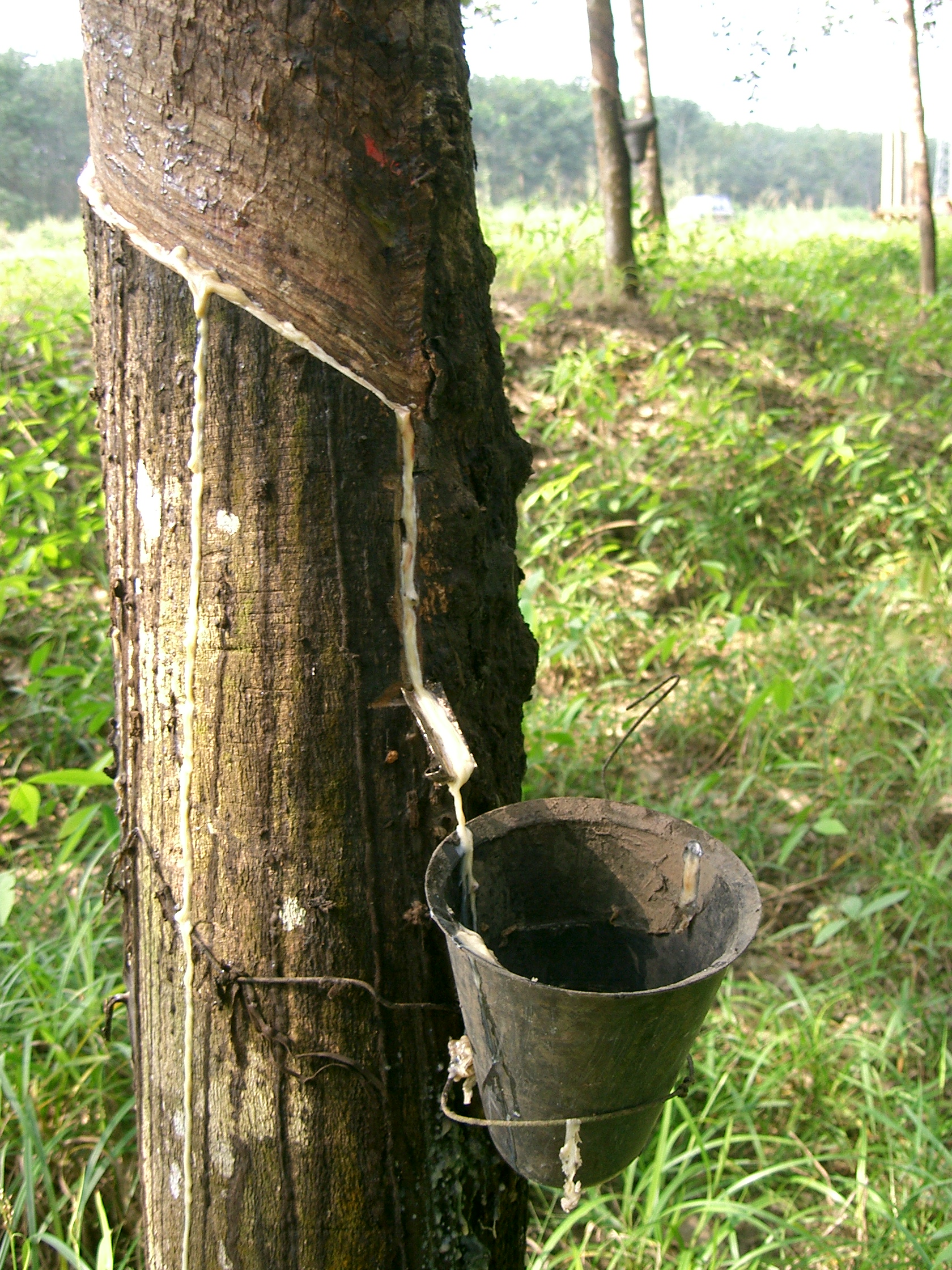
Rubber, known more organically as latex was first  found naturally in plants. Much like how syrup comes naturally from trees, a simple tap jammed into the trunk will strike a vein and drain the plant's harvest. This latex though, is pretty weak and flimsy with little structural integrity.

A tree being tapped for its latex

Vulcanization: One of the cooler scientific process names out there.
Through the use of chemistry, latex rubber from plants is combined with various compounds such as sulfur. These additives bind chemically with the rubber molecules to make it stronger. This sort of process is similar to how engineers add carbon atoms and other elements into iron to produce a much stronger form of metal, steel.

Today, much of the rubber we encounter is artificially made in some form or another from petroleum. This process can be more useful as it excludes some of the impurities found naturally in tree latex.

Not surprisingly, artificial rubber comes in some way from fossil fuels . For good measure, here's a page from the 2009 How the Energy Industry Works-an Insider's Guide 

A quick blurb about what 1 barrel of crude gets us

I'm not certain whether my enduring duo is made from vulcanized latex or synthetic rubber. I would guess it is synthetic since they've endured so much. I'm appreciative though that someone figured this stuff out. Used daily, thought of rarely.

Useful as they may be, shoes aren't all good


Friday, February 25, 2011

Straight from the Horse's Mouth

Budget cuts, the two words orbiting around so many debates. For the most part, it seems like a NIMBY case. Not In My Backyard. Yes, they are happening but it seems to never have landed near me. Well, this time it has.

For almost the last two years I have called UW Madison's Synchrotron Radiation Center (SRC) my home. And now it is set for termination. The SRC is a small particle accelerator laboratory that uses light to uncover the underlying properties of matter.

The SRC houses a machine that accelerates electrons near the speed of light around a baseball diamond sized track. This produces a broad spectrum of light frequencies scientists can use (like a microscope) to study matter.

"A person looks a lot different to an X-ray than with visible light. The same is true for other materials," said SRC physicist Cliff Olson.


The reality is what it is. There are a number of things involved in all of the politics that simply don't add up for a termination, it's just simply the "politics" word that we all like to blame. I will comment on one thing though.

The last line states that there are more powerful and capable facilities that surpass the SRC. This is true, the SRC accelerator is considered a 2nd generation light source and the standard today is the 3rd generation. We have designs for the 4th.

The accelerator, named Aladdin, housed at the SRC in Stoughton, WI during construction 1984

Most upsetting though is that a response like this is what sells the termination. An argument like this is a misconception, something that we internally believe: Bigger = Better. Much like how we say we shouldn't judge a book by its cover, we still do.

Saying that the SRC has been outdone by bigger laboratories is equivalent to saying that using a tennis racket in table tennis is much better because you can hit the ball harder.

Every mechanic, carpenter and builder knows the right tool is always essential. The SRC is being shut down and the official statement is not based on merited facts. I am continually reminded of why I do what I do to better communicate the idea of science.

Tuesday, February 15, 2011

The Black Box We All See

Shifting gears a bit. As a continuation off the first post about how science is not just done by scientists, is the fact that we are immersed in the resultants of scientific progress, every day.

It's not always easy to foresee the immediate benefits from scientific research. To demonstrate the significance of basic scientific research is to look at something we see nearly everywhere: The MP3 player

This is just one example of the many things we take for granted everyday. However, it should never be assumed that science just progresses as if it were a mechanical clock. Behind every single innovation was someone who sat down with a pen and paper and started drawing, inventing and creating.

Do you know how your cell phone really works? Someone created it by challenging common knowledge. Thankfully, people are not black boxes.

Sunday, February 6, 2011

Bicycles and the City: A list guide for survival and sanity

Included in almost every car advertisement is a blurb about the car’s fuel efficiency. Measured in miles per gallon, this tells us how far we get with a measured amount of fuel. Despite the continually increasing “mpg’s” we see, cars are horrible wasters of gas. Check out this chart of fuel efficiencies:


Bicycles are a model of efficiency. Wikipedia says they range from 80-99% efficient. A lot of the juice we put into the pedals comes out favorably as forward motion. Bikes are great.  Exercise, a breeze in your hair, no traffic jams, and some feel goods about not wasting money.

In no place is the bike best suited than a bustling city. All of these benefits are sure to follow so long as you don’t contend face-to-face with that 2-ton inefficient monster known as an automobile.

This is a seemingly obvious list to help you keep things sane. 

1) Helmets: Whereas it was uncool to wear a helmet in our younger years, today it says a lot about the head its protecting. I think of it as someone expressing humility, recognition of mortality. Simply put--your body can take a beating, your head cannot.
  
2) Best offense is a good defense? As far as the totem pole goes for city commuting, bikers are on the lowest end. Think of it as a glorified and unfair game of rock paper scissors. Car beats all, but cars can be trumped by pedestrians and the following lawsuits. It’s best to assume that bikes  lose no matter what you throw. There are many of cases where bicyclists are involved in an accident and inherit all of the blame and fines, despite having to go to the E.R.

3) Buses…There is one rule only. Don’t mess with them, period. Do not: go around them, in front of them, or behind them (for the sake of breathing.) They are cumbersome and unforgiving.


We can use physics for an absurd example:

Physics has a formula to measure how much Oommph or force a moving object has. If we calculate it out, a bus driving 25 m.p.h. has 768,350 Newtons and a bicyclist driving the same speed has about 3,932 Newtons.

What is a Newton? It’s a unit of force similar to how  we use pounds to measure weight. 1 newton is about 1/5 of a pound, so say a nice sized apple.
Take the bus’s apples and subtract them from the bicyclist's:
768,350 – 3,932 = 764,418 (more apples than you had) This means the bus stole all your thunder and continued to give you all of its remaining thunder in the form of pain.

Ok, so no one needs an equation to know that a bus will destroy a bike, it’s not a bad idea though to look at it from another viewpoint to drive it home. Keep your distance.

4) Blinky lights: As nighttime falls a bicyclists turns into a phantom. Scooting silently through the street canals masked within the periphery of an automobiles limited headlights. For these midnight hours there are many products out there built to obnoxiously announce that there is another being sharing the road. Quickly flashing LED lights keep you safe.
  
5) The Moment of Truth: The psychology of being knocked off your bike by an automobile is a perturbing event, to put it lightly. 

What happens: You are on your way to your destination and through a blinding mix of probabilities, a car is on a one-way course to ruin your day. Your mind will be at peace as you soar in slow-motion through the air. After a quick inversion from going over the handlebars you will land with the shocking force of everything reality has to offer. 

After realizing a few seconds later that you’re okay, just bleeding, you will notice the automobile driver still there, stopped with no expression. They remain in their fortified cocoon sealed off from all pandemonium in and around you. The car has not a scratch, it didn’t move one bit. You have repairs, a limp and the most unsettling feeling in your gut, you are so fragile and vulnerable with few to empathize or even sympathize.

Moving forward:

Number 5 is no good. So stay away from it, use your head and protect it. You'll be okay on a bicycle. Alternatively, just ride a bus and have an apple--both are financially smart and healthy things to do.

Sunday, January 30, 2011

Science of Rock 'n' Roll

Rock 'n' Roll can be studied to death but no academic analysis will ever reveal what makes it simply ROCK. From drum lines to guitar riffs, from the gritty to the outrageous, rock 'n' roll is something we just recognize. Forget nailing it down with words, we know it when we hear it.


However, if anyone has ever turned on a rock radio station in the last 40 years they've heard the most transcendent sound in the genre, distortion.

Distortion is the gritty sound we hear from a combination of the guitar, its amp and some other gadgetry. It's omnipotent presence in rock makes it at times unnoticeable, part of the background foundation of sonic chaos that makes up music

To get a few things straight. This demo shows the difference between a guitar that has no distortion and then shortly after, what that same guitar sounds like with a distorted sound.

But what exactly is distortion? What gives it that sound? To answer this, we need to take a trip to the sonic world of sound waves. From vibrating guitar string to our ears, this is the journey.

To start, an electric guitar uses magnets to translate physical vibrating strings into electronic signals. When recorded, the sound wave looks like this:

     A pure musical note. Imagine humming "oooo." Or listening to a single vibrating guitar string. Listen here

This is what's called a sine wave and this is what your ear is hearing. For the rest of this post, remember that the images you are seeing are actual representations of the sound pressure air waves you're eardrum is experiencing.

Distortion is exactly how it sounds, the original signal gets shaped, shifted, squished, stretched and overall, distorted:

    The same pure musical note after being "distorted." This change in the shape is picked up by our eardrum as being slightly gritty and more aggressive. Listen here

Distortion is a naturally occurring event in electronics. Typically, distortion in electronics is not a good thing because it muddles the original signal and the accuracy of the contained information is skewed. For example, distortion in a computer is not a good thing. Rather, pure signals like the first image are preferable.

However, for our intrepid interpreting eardrums, this results in an entirely new perception of the sound, attributing to perhaps a different mood.

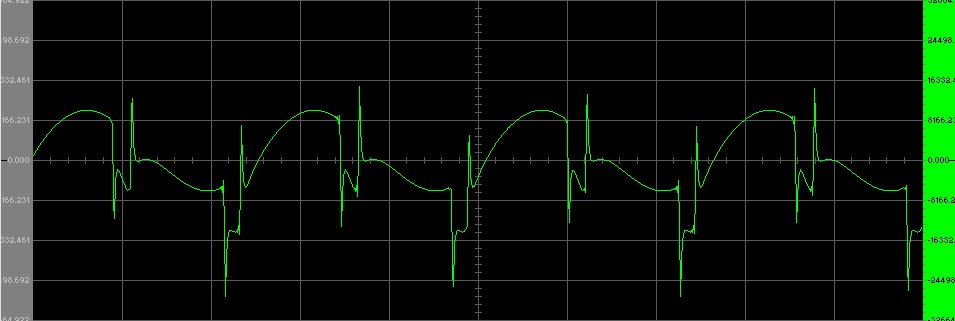
Pushing the distortion further will increase the sound to a harsher and more intense sound:

   This is an intense amount of distortion. Notice the straight vertical drops. Listening to the example shows that this case of distortion has a hard, bleating sound, almost like a buzz saw. Remember that this wave coming out of a speaker is the exact wave that is hitting your eardrum. Your eardrum is being smacked by blunt sound waves. Listen here

The rabbit hole doesn't stop there. Any number of mixes of distortion can be achieved. Some intense sounds can look like this:

    It's hard to imagine, but speakers make waves in these shapes. When you hear this, the air pressure waves are actually shaped like this. Listen here


That's all, this is one of the gremlins behind rock 'n' roll.

---------------------------------------------------------------------------------------------------------
A few housekeeping details and clarifications:

In this day and age, when science is being broken down into simpler components, the author always wants to say "in general, to roughly depict, this is a crude approximation of." Our science knowledge delves deep and within, is a quite complex world. This post is no different and it is safe to assume that whenever a general physics lesson like this is presented, there is a netherworld of items complicating the picture. Rest assured though, the fundamental principles remain.

For example. The very first image we saw earlier:


This is not what a vibrating guitar string signal looks like. This is a computer generated sine wave at 180 Hz.

A guitar string looks more like this:

    This is a vibrating A string on a guitar, not so "siney" looking.

Tech Notes:
For all images:
X-axis: Time
Y-axis: Voltage

Where did the images of the graphs come from:

Using my computer and some common guitar distortion making devices known as pedals:

The black box is the distortion pedal that controls the amount of distortion for the outgoing signal. 

Thursday, January 27, 2011

Seeing the Unseen: A Recently Completed Scientific Instrument Allows Scientists to See Deeper and Clearer into Materials

Appearing in Wisconsin Week, an article I wrote about a new imaging device that utilizes infrared light to help researchers peer into all types of biological forms. Click on the image for larger text: