Monday, September 5, 2011

A Highly Controllable Magnetic Substance with Potential Uses in Ultra-Fast Computers

Below is a press release I wrote while working at Helmholtz-Zentrum Berlin, a synchrotron laboratory where researchers use various flavors of light frequencies to study matter. Click on the images for larger text.


Wednesday, April 27, 2011

The Root of all Juice


We're going to play a game. It's called, find the power source. Ready go:


Okay, maybe that one was little much, try this:
The answer we're looking for here is the 3V Battery. 

So what does this have to do with anything? Anyone who has ever have used an electronic device has encountered it. It's where it all begins, simply put, the supply of power. Whether it's a AA battery or a cord that channels the juice from the wall outlet. This symbol is the most important.

The electronics schematic symbol for a cell


It's the source of that jumbled mess up top, but it's also in every electronic device you'd come across. Ipods to plasma screens all run on that simple electron (electricity) producing source. The point of all this is that someone sat down with a pen and paper and started with that symbol and worked their way forward, manipulating the electric juice as it flows through the wires. 

Using a slew of odd looking components like resistors and integrated circuits, the electrical engineer is the master creator of all things modern.

An integrated circuit-not a 21st century centipede
Classic resistor
Objects like these are in charge of doing one thing, altering the electrical signal that passes through them. In the end, electronics are nothing more than tons of well-manipulated signals that are either ON or OFF. Imagine how a computer comes of that?

Sadly, the knowledge of electronics seems to be slipping away. It is fair to say we are riding on the backs of a small percentage of the population's intrepid electrical engineers who can take electrons flowing from a battery and turn it into music with a picture of the album.


Going Further:

While the symbol for a cell is the simple drawing of vertical and horizontal lines, there are other sources of power than just a battery (which actually is a combination of several cells).

Others include DC power supplies:

A representation of DC power-- what comes out of a AA battery


Or AC power supplies:

The power that comes out of the outlets

 Both are two different creatures and their behaviors are much different as far handling them in the circuitry. The symbols are not universal, but the idea is consistent throughout schematic drawings. For example look at the first image and notice that its power supply says: " +9 to 12VDC." It just means the juice ranges from 9 volts to 12 volts direct current (DC).


Thursday, April 7, 2011

Why Corporations Still...

"Hey thanks for calling today, we'll definitely get your information off to someone and they'll be in touch soon." said Budweiser and MillerCoors PR departments.

It could be the typical journalism woes but it makes me wonder. Are Budweiser and MillerCoors beer brewing companies, or just a companies that happens to brew beer?


There is no doubt that they are the power house of the beer brewing industry in this country and that they are the kings of consistency. Brewers around the world highly respect these companies for what they do. What do they do that's so special? Aside from making a popular pilsner style beer they make a lot of it.

Brewing beer is a labor intensive process but the hardest part comes at the end. The final ingredient, yeast, are one of the most temperamental critters out there. Brewers must constantly pamper their yeast like rockstars. One mistake, no matter how minor could throw the entire brew off-balance. Miller and Budweiser have figured out how to do this and it's nothing shy of a scientific and technological wonder.

Copper kettles for the boiling portion of beer brewing.

Yeast laboratories and Ph.Ds in microbiology and physiology are what it takes to understand this deceptively simple single-celled organism that could. With all this success though comes the infrastructure to manage it all, the corporation.

Billions of yeast cells all go into making every batch of brew

This is what makes me now wonder, after having talked with so many in the brewing world. Are Miller and Budweiser about the craft of brewing? After many repeated attempts to get a brief interview from either, I never received a reply.

Budweiser's PR department though did want me to know that

"We use beer brewer's yeast, not baker's yeast."

Wednesday, March 23, 2011

Making Sense

The nuclear crisis in Japan is scary, a lot of potential for disaster. The fury of media coverage has been nice and I feel for the most part, they are showing a good deal of useful information to explain the situation. Yesterday I sat in on a session led by two nuclear engineers and medical physics expert who gave a no frills assessment.

Surprisingly, the scientific level of these media coverages is pretty intense, lots of jargon. I thought I'd do my part and briefly explain some key elements to nuclear reactors.

What is a nuclear plant?


Power plants using nuclear fuel are just a reinvention of the mousetrap. All power plants do one thing, make steam to drive a turbine. That spinning turbine makes electricity and the means to do that though varies. In reality, all power plants carry the risk of explosion because they all handle high-pressure steam.

Firstly, nuclear reactor plants do not explode on account of their nuclear fuel. There just isn't enough percentage of radioactive substance to trigger the massive explosions we're familiar with.

How do they work?

Nuclear reactors work by using a small yet critical amount of radioactive material that creates a chain reaction. When all of the variable line up the reaction produces heat, which can be used to boil water.

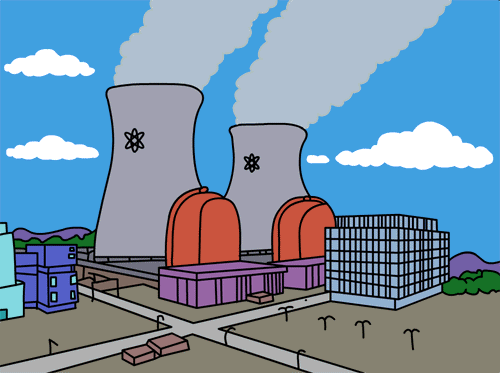
Nuclear power plant cooling towers. These are just big tubes where the steam is recycled. There is a perpetual rain shower inside due to the steam climbing, cooling, and then raining back down. The plant then re-heats the water and makes electricity once more.

Fuel Rods: These are the main source of energy and contain the primary radioactive materials used to create the heat. They are triggered by neutrons. When neutrons are flying around the fuel rods, a lot of energy is being released.

-More info about the entire fission process as a result of neutrons HERE Someone has already said it better than I could.

Control Rods: These are neutron absorbing rods that can be inserted into the chamber where the fuel rods are producing heat. The control rods help stop the bombardment of neutrons and can stop the reaction in the fuel rods all together.

A simple diagram showing the basics of nuclear plant designs

The bottom line: Japan's reactors are in danger due to power failures. The plant's main power supply was damaged as a result of the earthquake and tsunami. The facility did have backup battery power but those eventually ran out. Without the electricity they were not able to keep the water pumps running.

These water pumps are essential in keeping a continuous supply of cool water to absorb the heat and keep things at a manageable temperature. If they cannot be cooled, steam builds and so does the pressure inside the reactor core and housing. The engineers are able to release some of the steam but that is risky because it's a direct release of radioactive materials into the atmosphere.

Some tech'ier stuff:

The Fukushima Daiichi plant reported that once they detected seismic activity they began the fission shutdown process. Inserting the control rods successfully stopped the primary fission process in all 6 reactors. Within the fuel rods though are highly-radioactive elements that continue decaying and radiating large amounts of heat.

There is also the issue of hydrogen gas buildup as a result of water oxidizing with the metals in the reactor. Hydrogen gas is very flammable and can be cause for more troubles.


Something unclear? Science need a little tweaking? Let me know in the comments.

Monday, March 7, 2011

Two of a Kind Deaths

1967 and Wisconsin lost the race. The bid for the United States National Accelerator Laboratory, more commonly known as Fermilab, went to Illinois. Construction of the 3.9 mile in circumference proton smashing particle accelerator marked the opening of one door and the closing of another.

Fermilab

MURA-The Midwestern University Research Association disbands and leaves a legacy that would continue until present day. The Synchrotron Radiation Center-a successor to Tantalus.

MURA's mission after the 1950's was to bring a high-energy physics presence to the midwest. Through a consortium of around 20 universities the physicists were able to land Fermilab near Chicago. This marked the end of MURA as an organized group. Many of the MURA physicists, based in Madison, left in numbers to build our nation's biggest particle accelerator.

One of the early MURA tinkerings with particle accelerators in Madison 1957

A few stayed behind and started a new breed of accelerators and through several serendipitous events, they too marked a place in history. Known as Tantalus, the physicists created the first light producing accelerator dedicated for researchers using light to study matter in 1968.

Particle Collider vs. Light Source

The word particle accelerator has come to take on a dual personality. While the machines that we've heard of such as CERN or Fermilab do accelerate particles, they are of a different and extravagant breed of machines.

Accelerators such as CERN whirl protons in opposite directions around a race-track near the speed of light. The scientists and builders aim to witness a cosmic collision of forces. Why?

If you wanted to know how a watch works, you could smash two of them together and see what parts and pieces come flying out. The same is true for small constituent parts of matter, such as protons. These efforts attempts to scratch our itch to better understand what our world is really made of.

A microscopic colossal collision. Two protons smashing head-on and their resultant splatter

Light sources are of a more practical breed. Instead of smashing, they whirl particles around the racetrack. Not nearly as exciting as an epic collision but quite useful. Every time something like an electron goes around a corner at fast speeds, it emits light. This light is used to study matter, like a microscope. Scroll down a few posts until you see the ipod. Most of those technologies came from light source research.

'til Death do them 'part

Fermilab-the proton smasher and Tantalus-the electron whirling, light-producing extraordinaire were born at the same time. Coincidentally, they are set both set for shutdown this year.

Given the recent political atmosphere and governmental budgetary belt tightening, some science is taking a hit. Fermilab and Tantalus' successor, the Synchrotron Radiation Center have been set for termination as a result of their old age--so says their funding agencies.

Despite the bleak outlook, there is something very poetic about the turn of events and their timeliness.

Thursday, March 3, 2011

A Mile or Two

This duo has been with me since 2004, I'm impressed. A simple pair of slip-on shoes that have traveled two continents and countless miles. I hate to think of the day when they won't be by my side, or underfoot that is.


These slip-ons recently accompanied me on my first journey to our nation's capital, Washington D.C. where they put on the miles as I journeyed (as I believe all should) to see the monuments. As I went the distance around the city I was reminded of the progress we've somehow managed to create in every aspect of our lives. With that, let's take a stroll down the history of how rubber transforms from goopy tree product to slip-on shoe that becomes a part of you throughout the years.

 
Action shot


A full description of both natural and synthetic rubber can be found conveniently at this Wikipedia site. But for all with just the passing intrigue. These are the highlights:

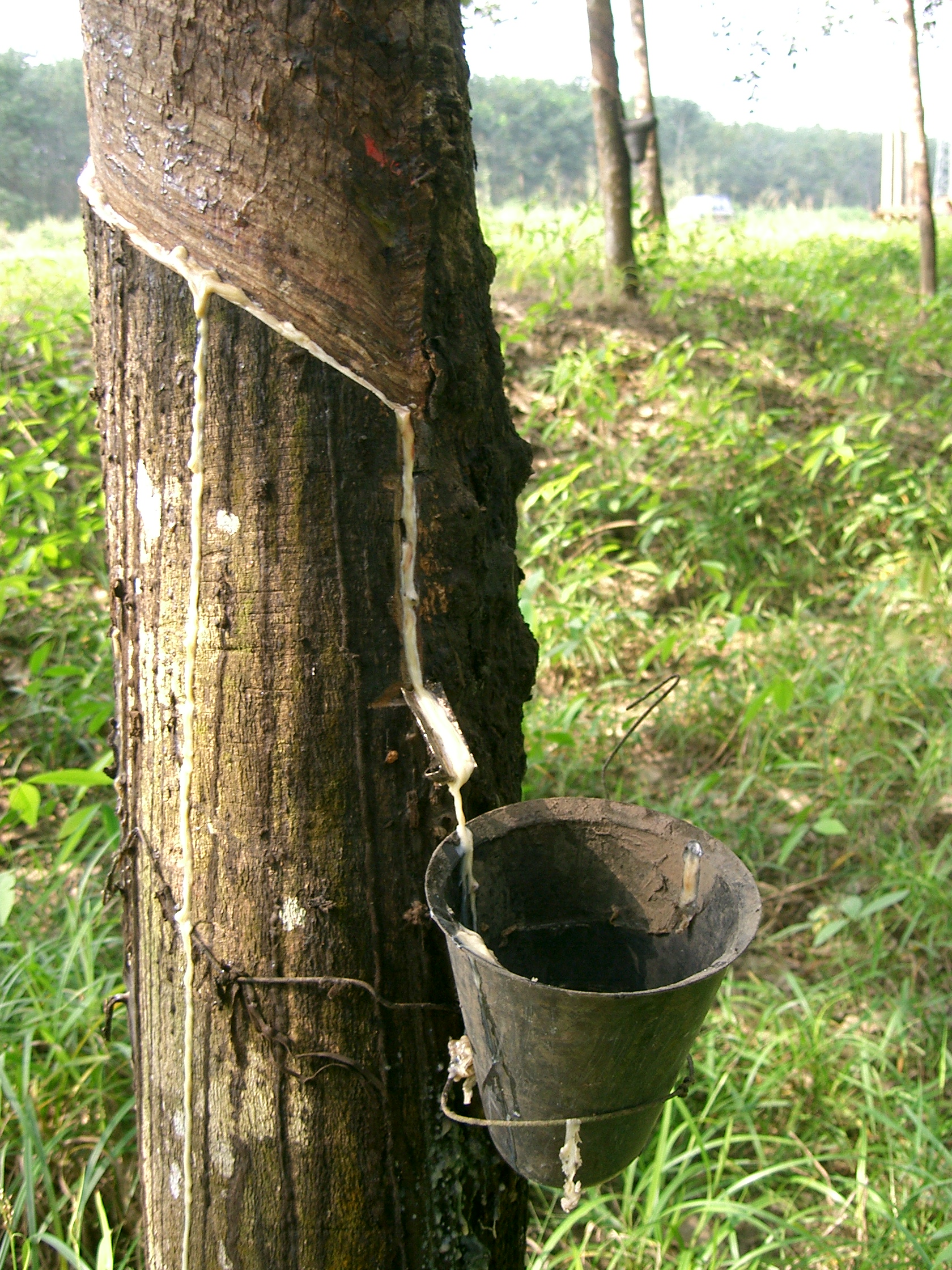
Rubber, known more organically as latex was first  found naturally in plants. Much like how syrup comes naturally from trees, a simple tap jammed into the trunk will strike a vein and drain the plant's harvest. This latex though, is pretty weak and flimsy with little structural integrity.

A tree being tapped for its latex

Vulcanization: One of the cooler scientific process names out there.
Through the use of chemistry, latex rubber from plants is combined with various compounds such as sulfur. These additives bind chemically with the rubber molecules to make it stronger. This sort of process is similar to how engineers add carbon atoms and other elements into iron to produce a much stronger form of metal, steel.

Today, much of the rubber we encounter is artificially made in some form or another from petroleum. This process can be more useful as it excludes some of the impurities found naturally in tree latex.

Not surprisingly, artificial rubber comes in some way from fossil fuels . For good measure, here's a page from the 2009 How the Energy Industry Works-an Insider's Guide 

A quick blurb about what 1 barrel of crude gets us

I'm not certain whether my enduring duo is made from vulcanized latex or synthetic rubber. I would guess it is synthetic since they've endured so much. I'm appreciative though that someone figured this stuff out. Used daily, thought of rarely.

Useful as they may be, shoes aren't all good


Friday, February 25, 2011

Straight from the Horse's Mouth

Budget cuts, the two words orbiting around so many debates. For the most part, it seems like a NIMBY case. Not In My Backyard. Yes, they are happening but it seems to never have landed near me. Well, this time it has.

For almost the last two years I have called UW Madison's Synchrotron Radiation Center (SRC) my home. And now it is set for termination. The SRC is a small particle accelerator laboratory that uses light to uncover the underlying properties of matter.

The SRC houses a machine that accelerates electrons near the speed of light around a baseball diamond sized track. This produces a broad spectrum of light frequencies scientists can use (like a microscope) to study matter.

"A person looks a lot different to an X-ray than with visible light. The same is true for other materials," said SRC physicist Cliff Olson.


The reality is what it is. There are a number of things involved in all of the politics that simply don't add up for a termination, it's just simply the "politics" word that we all like to blame. I will comment on one thing though.

The last line states that there are more powerful and capable facilities that surpass the SRC. This is true, the SRC accelerator is considered a 2nd generation light source and the standard today is the 3rd generation. We have designs for the 4th.

The accelerator, named Aladdin, housed at the SRC in Stoughton, WI during construction 1984

Most upsetting though is that a response like this is what sells the termination. An argument like this is a misconception, something that we internally believe: Bigger = Better. Much like how we say we shouldn't judge a book by its cover, we still do.

Saying that the SRC has been outdone by bigger laboratories is equivalent to saying that using a tennis racket in table tennis is much better because you can hit the ball harder.

Every mechanic, carpenter and builder knows the right tool is always essential. The SRC is being shut down and the official statement is not based on merited facts. I am continually reminded of why I do what I do to better communicate the idea of science.